The essentials
- Mid-December gives about 3.1 hours between sunrise and sunset, with long blue twilight either side of it.
- Fairbanks is at 64.9 degrees north, so the sun rises every day of the year and sets every day of the year.
- The city sits beneath the band where auroral activity concentrates, which is why it is one of the best places on earth for it.
- Aurora needs darkness rather than cold, so it begins in late August and ends when the light returns in April.
What 64.9 degrees north actually means
Fairbanks sits at about 64.9 degrees north, which puts it roughly a hundred and eighty kilometres south of the Arctic Circle. That distinction is the single most misunderstood fact about the place, and it decides everything else on this page.
Above the Arctic Circle there is at least one day a year when the sun does not rise and one when it does not set. Fairbanks is below it, so neither happens. The sun rises every single day of the year here, and it sets every single day.
What it does instead is skim. In midwinter it clears the horizon for about three hours and never gets far above it; at midsummer it dips below for a few hours and never gets far under. The extremes are of angle rather than of presence.
Midwinter, and what three hours looks like
Mid-December gives about 3.1 hours between sunrise and sunset. That is the raw figure and it undersells the day badly, because either side of those three hours is a long, slow twilight in which you can read a trail perfectly well.
The colour is the thing. Snow lit by a sun sitting just below the horizon goes a deep saturated blue that has no equivalent at lower latitudes, and black spruce stand against it in silhouette. Photographs taken in it look manipulated and are not.
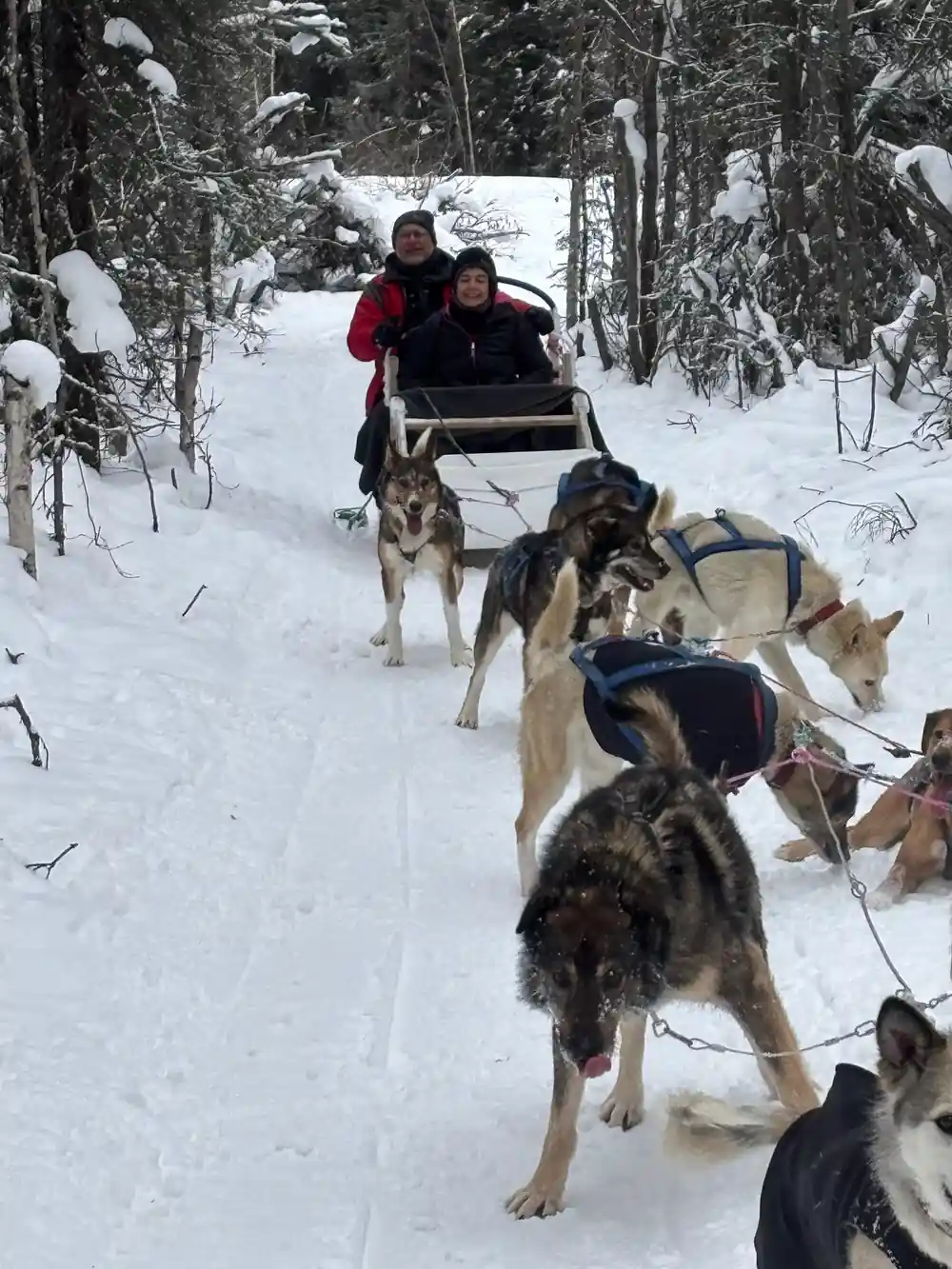
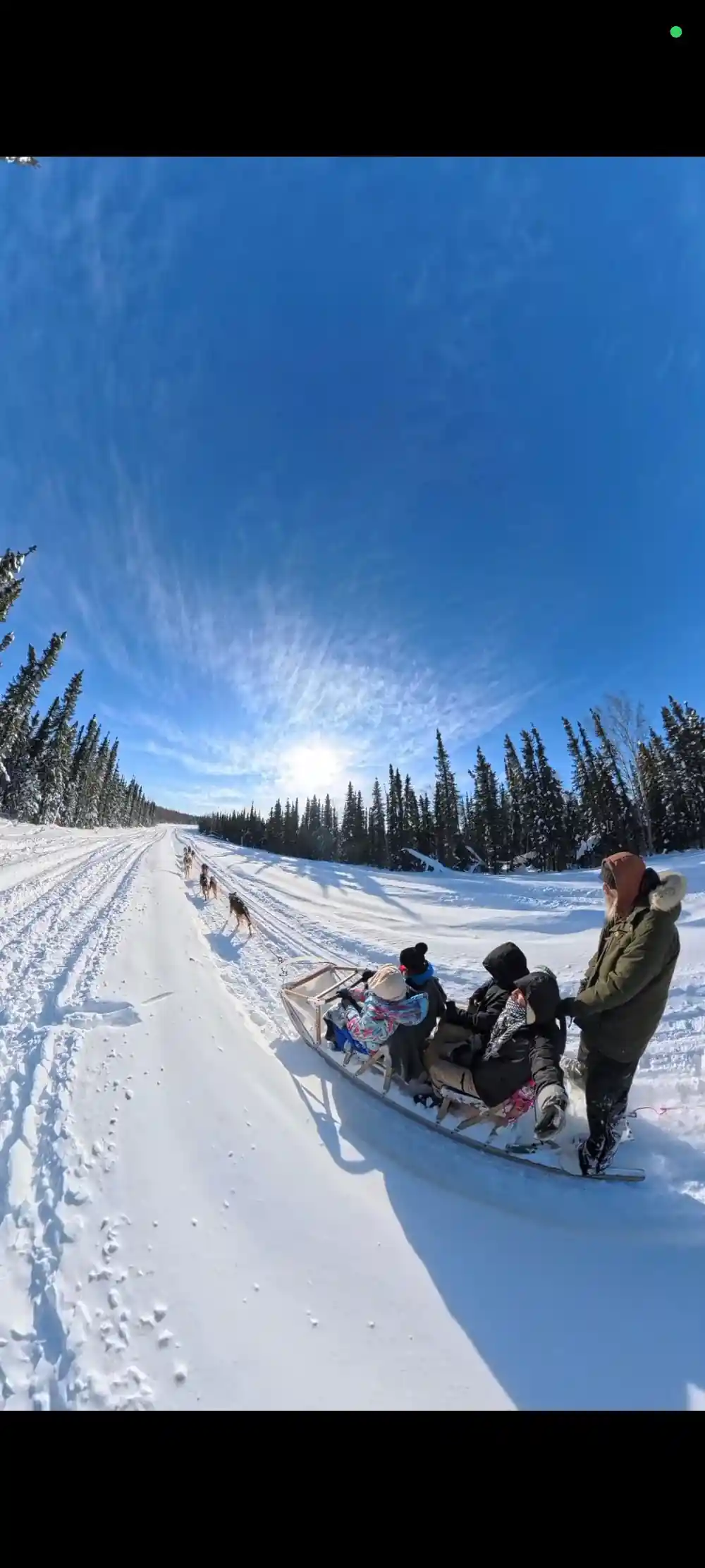
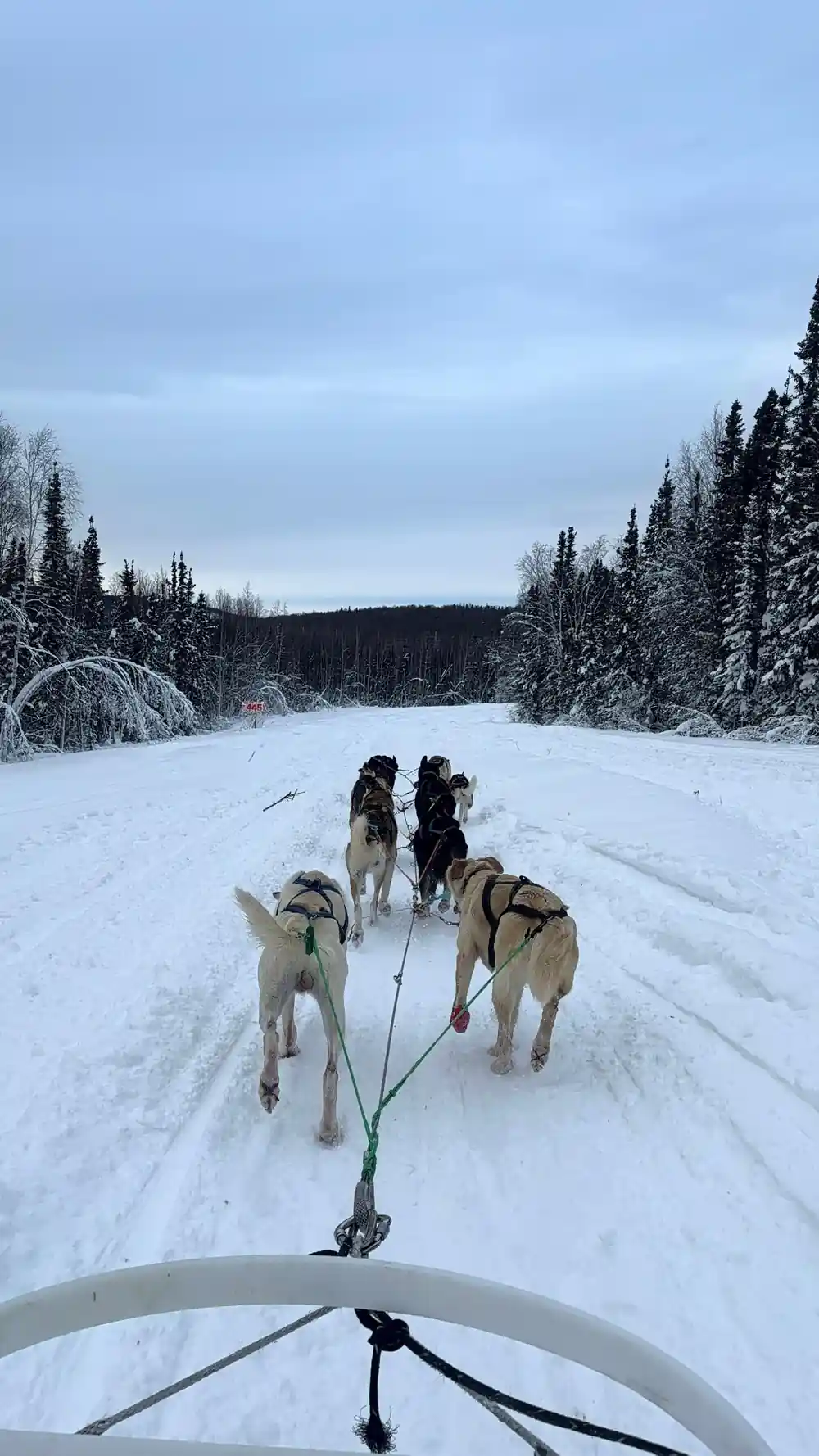
A sled ride in December therefore happens largely in twilight rather than in darkness or in daylight, which is both the most atmospheric version of the trip and the hardest to photograph.
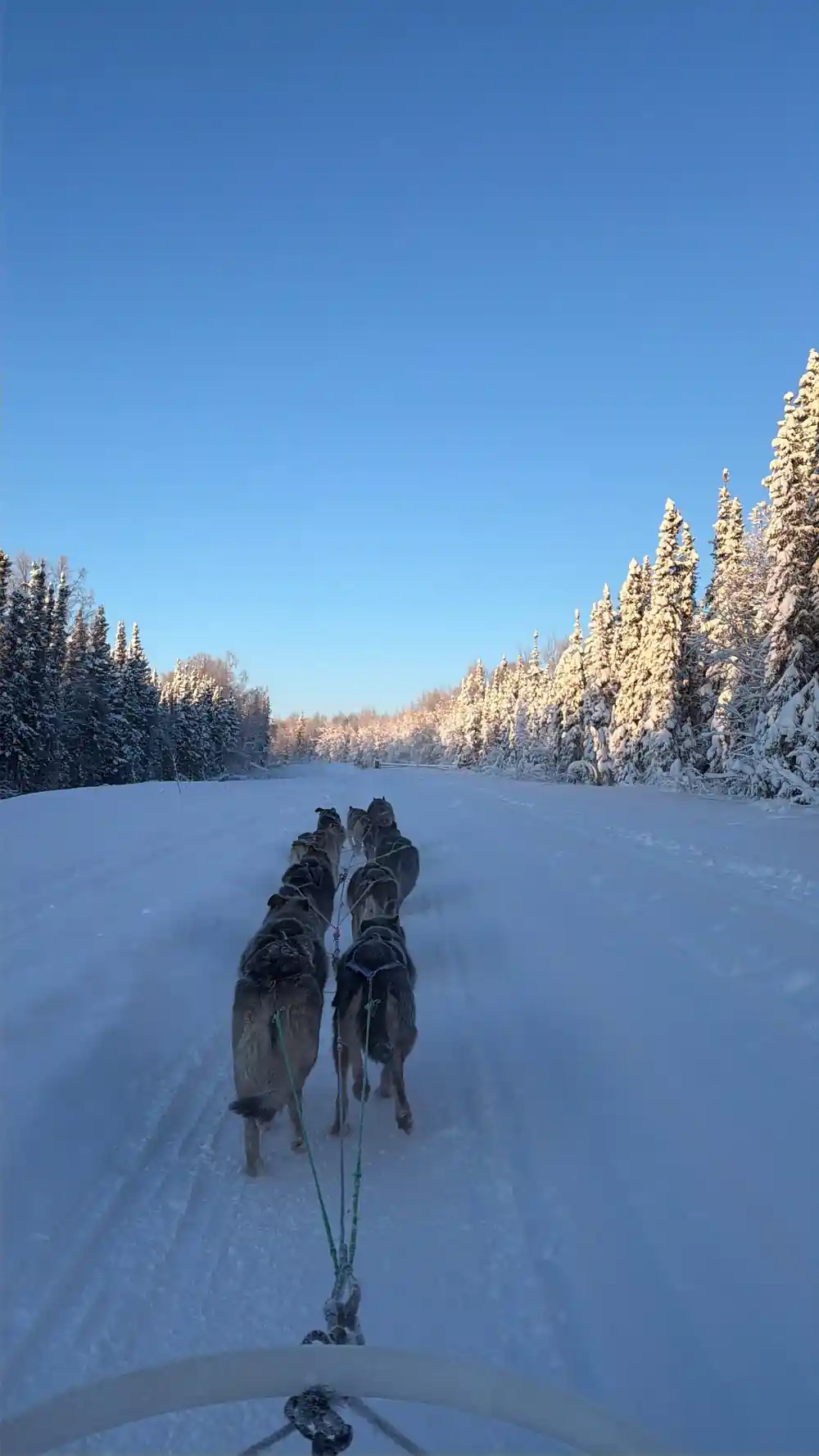
Blue twilight over black spruce, which is what a December afternoon looks like here
The light coming back
The recovery is fast and it is noticeable across a short stay. Mid-January is at 4.5 hours, February at 8, March at 11.2 and April at 14.8. Through late January and February, Fairbanks gains something in the order of seven minutes a day.
The practical effect is that a March visitor and a December visitor are looking at two different places. March gives you full daylight for a ride and a landscape you can see to the horizon; December gives you blue twilight and a much stronger sense of being somewhere remote.
Neither is better. But they are different enough that it is worth choosing deliberately rather than letting a flight timetable choose for you.
Summer, and the sun that does not quite stay up
Mid-June gives about 20.9 hours of daylight. The sun does set, briefly, but it goes so shallowly below the horizon that it never gets properly dark: what follows sunset is civil twilight lasting until sunrise.
Fairbanks makes a great deal of this and is entitled to. The city plays an annual baseball game starting late in the evening of the solstice and finishing after midnight without artificial light, which is a better demonstration of the phenomenon than any number.
It also means the aurora is invisible from roughly late April to late August, no matter what the sun is doing. There is simply never a dark sky to see it against.
20.9 h
Daylight at Fairbanks in mid-June. The sun still sets, but so shallowly that the night never becomes properly dark: this is well south of the Arctic Circle.
Why the aurora is so good here
Auroral activity does not spread evenly across the polar regions. It concentrates in a ring, the auroral oval, centred on the geomagnetic rather than the geographic pole, and Fairbanks sits almost directly beneath it.
That geography is worth more than latitude alone. Places considerably further north can sit inside the oval rather than under it and see less. Fairbanks gets displays overhead rather than low on the northern horizon, which is a different experience entirely.
Add the dry, clear, cold winter air described on the weather page, and the combination is about as good as the phenomenon gets from an accessible town with an airport.
When to look, and from where
The season runs from late August to mid-April, because it depends on darkness. Within it, activity is not seasonal but visibility is: the clearest skies come with the coldest air, so the deepest part of winter is often the most productive.
The hours around local midnight are the usual window, though displays occur at any dark hour. Patience matters more than equipment: the standard advice, which is correct, is to give it several nights rather than one.
You want to be away from town lights. That is the main argument for a car in Fairbanks, or for a dedicated evening tour, and it is a separate activity from a daytime sled ride.
One practical note for a short trip: check the aurora forecast by all means, but do not let it govern your plans. The published indices predict geomagnetic activity rather than cloud cover, and cloud is what actually decides whether you see anything on a given night in Fairbanks.
Seeing the lights from the sled
It is not what this tour is for. A one-hour daytime ride is a daylight or twilight activity and should not be booked as an aurora hunt.
That said, in the depth of winter the boundary blurs. A late-afternoon ride in December is happening in twilight, the kennel is outside town, and if activity is high and the sky is clear something may well be visible. The guides will notice before you do.
Treat it as a possibility rather than a plan. Book the ride for the ride, and the aurora for the aurora.
A December ride happens in blue twilight, not daylight
from US$175Reserve now & pay later